C.1.2 Flux enhancement and altitude dependent velocity distribution
The velocity distribution given in Table C-1 is modified by the gravitational attraction of Earth.
In case of a single velocity value the flux increase due to Earth gravity at a given distance r of the centre of the Earth is described by the factor G which is given by
|
|
(C-1) |

or
|
|
(C-2) |

with
|
|
(C-3) |

G describes the factor by which a particle flux a large distance from Earth, is enhanced when measured near to Earth, due to the gravitational bending of trajectories (causing an increase in particle spatial density) and increase of particle velocity [RD.121].
Using the product μ of the constant of gravitation with Earth’s mass (μ = 3,986 105 km3s-2), the escape velocity at distance r can be written as
|
|
(C-4) |

and v∞ is the velocity in free space, i.e. in the absence of Earth’s gravity which is tabulated in Table C-1, and v is the ‘enhanced’ meteoroid velocity at distance r. To obtain the correct flux enhancement in case a velocity distribution is given we realise that G is a function of v∞. Thus the enhanced flux FE is obtained from the flux Fmet,0 by
|
|
(C-5) |
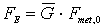
with
|
|
(C-6) |
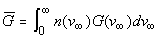
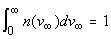
 is the weighted mean G
factor for a given velocity distribution. This assumes that the velocity
distribution n(v∞)
has been normalised:
is the weighted mean G
factor for a given velocity distribution. This assumes that the velocity
distribution n(v∞)
has been normalised:
|
|
(C-7) |
The above formulas contain the necessary information to calculate the altitude dependence of the velocity distribution, since we can write
|
|
(C-8) |

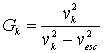
With nk = n(v∞,k) and n’k = n’(v,k) representing the tabulated values for the original distribution function and for the distribution function at distance r respectively. N gives the number of bins used for the velocity distribution. Given the escape velocity at distance r, vesc and the tabulated values of n(v∞) in 1 km s-1 bins nk, we calculate the values n’k for the distribution n’(v) at distance r by
|
|
(C-9) |

with
|
|
(C-10) |
and
|
|
(C-11) |
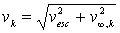
If we now tabulate the values of n’k we need to change the bin limits by inserting the values of v at the places of the given values of v∞ which is done by using again the formula
|
|
(C-12) |
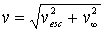
As a result the bin widths are now no longer equidistant in v, which is the independent variable of the new distribution function n’(v). The new distribution function is re-normalized and re-binning is required by interpolating the values of n’(v) to obtain equidistant bins in v. This completes the calculation procedure of the new table for the velocity distribution n’(v) at the given distance r.
The
gravitational enhancement, expressed by the factor, increases the flux due to a real increase in spatial
density of meteoroids due to Earth’s attraction and also due to the increase in
the meteoroids’ velocity. Expression (C-5) accounts for both effects.
Additional information and examples of modified velocity distributions for various Earth altitudes are given in Annex J.