9.5.2 Predictions of SEE rates for ions
a. Calculation of the ion contribution to SEE rates shall be performed as follows:
(a) Assume that the sensitive volume is a parallelepiped of the same volume as the sensitive one.
(b) Calculate the error rate using one of the following formulae:
-

with 

-
Blandford and Adams formula: 
where:
A = total surface area of the SV;
l, w and h = length, width and height of the SV;
dΦ/d(LET ) = differential ion
flux spectrum expressed as a function of LET (shortened to “differential LET
spectrum”);
) = differential ion
flux spectrum expressed as a function of LET (shortened to “differential LET
spectrum”);
PCL(>D(LET)) = integral chord length distribution, i.e. the probability of particles
travelling through the sensitive region with a pathlength greater than D;
LETMin = minimum LET to upset the cell (also referred
to as the LET threshold);
LETMax = maximum LET of the incident distribution
(~105 MeV×cm2/g).
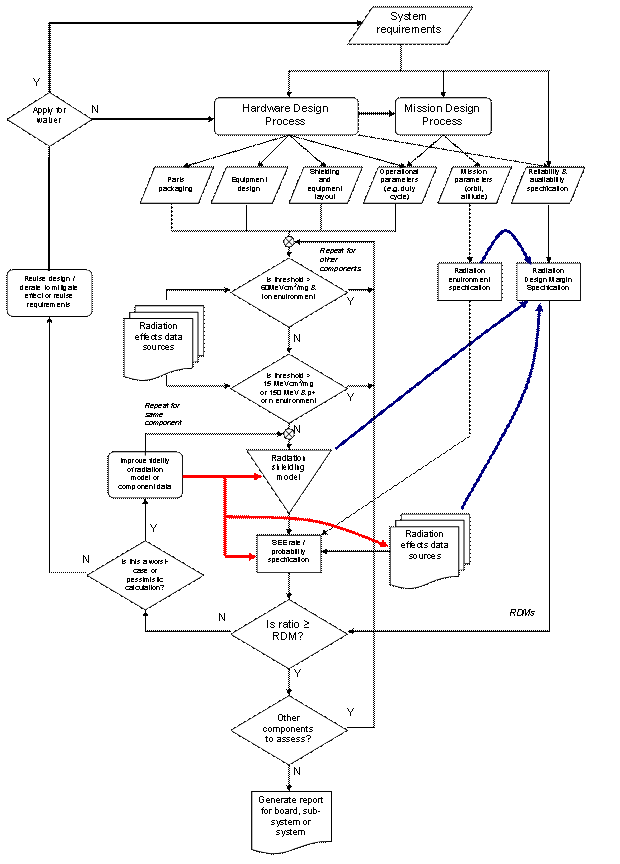
Figure 9‑1: Procedure flowchart for hardness assurance for single event effects.
(a) Use the real sensitive volume for the integration.
(b) Calculate the error rate using the following formula:

with 
where:
dF/d(LET) = differential LET spectrum;
PCL(>D(LET)) = integral
chord length distribution;
dsion/d(LET) = differential upset cross section;
A = total surface area of the sensitive volume;
S = surface area of the sensitive volume in the plane of the semiconductor die;
l, w and h = length, width and height of the sensitive volume;
DMax = maximum length that can be encountered in the SV;
LETMax = maximum LET of the LET spectrum;
LETi,Min = lower bin limit in the differential upset
cross section dsion/d(LET);
LETi,Max = upper bin limit in the differential upset
cross section dsion/d(LET).
NOTE For a detailed discussion of the RPP and IRPP approaches, see ECSS-E-HB-10-12 Sections 8.5.2 to 8.5.4. References can be found in [6], [7], [8], [9] and [10].