I.2.4 Spectrum of individual events
I.2.4.1. Overview
Solar proton event spectra are variable, the worstcase event at one energy is not necessarily worstcase at another. The August 1972 event yield worstcase doses at most typical spacecraft shielding (1-10 mm) where particles of energy 10-70 MeV are most important. The October 1989 flare is apparently more severe at lower and higher energies. Lower energies are important for surface material and solar cell effects and the higher energies more important for deep shielding (e.g. for heavy spacecraft, manned missions and planetary atmospheres) and for nuclear interactions giving rise to certain types of background and SEUs. Hence the term “worstcase” is application dependent.
I.2.4.2. August 1972 event
The August 1972 event produced a peak flux near the Earth in excess of 106 protons cm-2s-1 above 10 MeV energy. A fluence spectrum which is often used to represent a worst case flare, classified as “anomalously large” is based on the very large August 1972 event [RD.72]:
|
|
(I-8) |
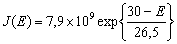
with energy E in MeV and fluence J in protons cm-2.
I.2.4.3. October 1989 event
The October 1989 event was the largest seen since August 1972 but had lower fluences at the medium energies. The events of 19, 22 and 24 October 1989 have been fitted to Weibull spectral forms as suggested by Xapsos et al [RD.73]. Account has been taken of ground level neutron monitors in addition to spacecraft data as suggested by Dyer et al [RD.74] in order to get the correct spectra at higher energies. The differential flux spectrum is given by the form:
|
|
(I-9) |

With energy E in MeV and the flux J in protons cm-2 s-1 sr-1 MeV-1. The parameters for the peak fluxes during these events are given in Table I-4.
I.2.4.4. Worst case
It has been proposed that a truncated power law can provide a good fit to the distribution of the log of the intensity of the solar proton events [RD.12]. Such a model predicts therefore a worst case event which is found to be 1,3E+10 cm-2 for proton with energy above 30 MeV. Consideration on the statistical uncertainty leads to estimate that an actual worst case is about 3E+10 cm-2.
The JPL approach is based on a good fit of the distribution of the log of the intensity of events through a Gaussian function. With the parameters given in Table I-2 above for the range > 30 MeV, a fluence of 3E+10 cm-2 is likely to not be exceeded by 99,5% of the events.